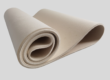
I. Overview of Endless Felt Belts
An endless felt belt is a continuous loop belt manufactured through specialized industrial processes. It is widely used in papermaking, textile finishing processing, printing, leather Industry, aluminum extrusion processing, and advanced material manufacturing industries.
Unlike traditional jointed belts, endless felt belts adopt a seamless structure. As a result, they operate more smoothly, distribute loads more evenly, and exhibit superior wear resistance and extended service life. Therefore, endless felt belts have become a key functional component in modern continuous production lines.
II. Production Process of Endless Felt Belts
Manufacturers produce endless felt belts by integrating textile engineering, needling technology, heat treatment, and precision finishing. Overall, the production process consists of the following key steps.
1. Raw Material Selection and Fiber Blending
First, manufacturers select appropriate fibers according to specific operating conditions, such as temperature, pressure, speed, and chemical exposure. Commonly used fibers include:
- Synthetic fibers, such as polyester, nylon, and aramid(nomex, kevlar)
- Natural fibers, such as wool and cotton, which are typically limited to low-load applications
By scientifically adjusting fiber ratios, manufacturers ensure that the belt meets both mechanical and functional performance requirements.
2. Web Formation and Layering
Next, manufacturers form fiber webs using cross-lapping or multilayer stacking techniques. During this process, fibers are oriented in both longitudinal and transverse directions. Consequently, the felt belt achieves excellent tensile strength and dimensional stability.
3. Needling Reinforcement
After web formation, manufacturers apply high-frequency multi-needle needling. This process interlocks fibers into a dense and uniform three-dimensional structure.
Moreover, needling directly determines key performance indicators, including:
- Belt density
- Compression resistance
- Elastic recovery capability
Therefore, needling quality plays a decisive role in overall belt performance.
4. Endless Loop Formation
The core technology of endless felt belts lies in seamless loop formation. Manufacturers typically achieve this through:
- Direct circular needling
- Precision thermal bonding followed by overall reinforcement
Through these methods, manufacturers eliminate joints and weak points. As a result, the belt runs smoothly without vibration or localized stress concentration during operation.
5. Heat Setting and Surface Treatment
Finally, manufacturers apply heat setting to stabilize belt dimensions. In addition, they may perform surface treatments such as singeing, calendering, coating, or perforation.
These treatments allow the belt to adapt to different equipment configurations and processing requirements.
III. Material Composition and Performance Characteristics
1. Main Material Types
| Material Type | Key Properties |
|---|---|
| Polyester Fiber | High strength, excellent wear resistance, and strong hydrolysis resistance |
| Nylon Fiber | High toughness and outstanding impact resistance |
| Aramid Fiber | Excellent heat resistance and cut resistance |
| Wool Fiber | Good water absorption and superior surface softness |
2. Structural Characteristics
Endless felt belts typically adopt a multi-layer composite structure. Specifically, manufacturers design:
- Functional surface layers
- High-strength internal support layers
Thanks to this structural design, the belts maintain stable performance under high pressure, high speed, and long-term continuous operation.
IV. Application Fields
1. Papermaking Industry
In papermaking machines, endless felt belts serve as:
- Press felts
- Conveyor felts
- Dewatering and forming support belts
Accordingly, they play a crucial role in dewatering efficiency, sheet support, transportation, and surface formation.
2. Textile and Dyeing Industry
In textile finishing and dyeing processes, manufacturers use endless felt belts for fabric conveying and heat setting. Meanwhile, their excellent heat resistance and surface flatness help ensure consistent product quality.
3. Leather Industry
Endless felt belts are widely applied in the leather industry, including:
- Leather dewatering processes
- Leather ironing and embossing operations
- Fur combing and finishing processes
Because of their high pressure resistance, wear resistance, and dimensional stability, they help maintain uniform leather surface quality.
4. Aluminum Extrusion Processing
In aluminum extrusion lines, endless felt belts support and protect aluminum profiles during forming and conveying stages. Consequently, they reduce surface damage and improve overall production efficiency.
5. New Energy and Advanced Materials
In recent years, endless felt belts have increasingly been used in continuous production lines for lithium battery electrodes, carbon fiber composites, and other advanced materials. In many cases, they gradually replace traditional conveying media.
V. Future Development Trends
1. High Performance and Functional Integration
In the future, endless felt belts will continue to develop toward higher temperature resistance, stronger chemical resistance, and ultra-high wear resistance. At the same time, manufacturers will integrate multiple functions into a single belt.
2. Precision Engineering and Customization
Meanwhile, market demand drives manufacturers to provide more customized solutions, including:
- Tailored thickness and density
- Customized surface functions
- Designs optimized for specific operating conditions
3. Green Manufacturing and Sustainability
From a sustainability perspective, future development will focus on:
- The use of recyclable fiber materials
- Energy-efficient manufacturing processes
- Extended product service life
As a result, endless felt belts will better align with green manufacturing principles.
4. Intelligence and Digitalization
Looking ahead, manufacturers may incorporate intelligent features into endless felt belts, such as:
- Embedded condition-monitoring fibers
- Service life prediction technologies
- Intelligent maintenance support systems
VI. Conclusion
As a fundamental component of modern continuous industrial production, endless felt belts directly influence equipment efficiency and product quality. With continuous progress in industrial automation and material technology, endless felt belts will further evolve in performance, structure, and application scope. Ultimately, they will move toward high-end, sustainable, and intelligent development.